
How Behaviour Profiling Can Help You Understand People and Build a Better Team
Understanding people is the key to better teamwork, leadership, and communication. Behaviour profiling gives you the tools to decode what drives others — and yourself. From hiring and team building to sales and leadership, profiling frameworks help take the guesswork out of human behaviour.
This article explores the most trusted behaviour profiling systems — from DISC and StrengthsFinder to MBTI, Kolbe, and Enneagram — and explains how each can help you become a more effective leader, communicator, and business owner.
What is Behaviour Profiling? 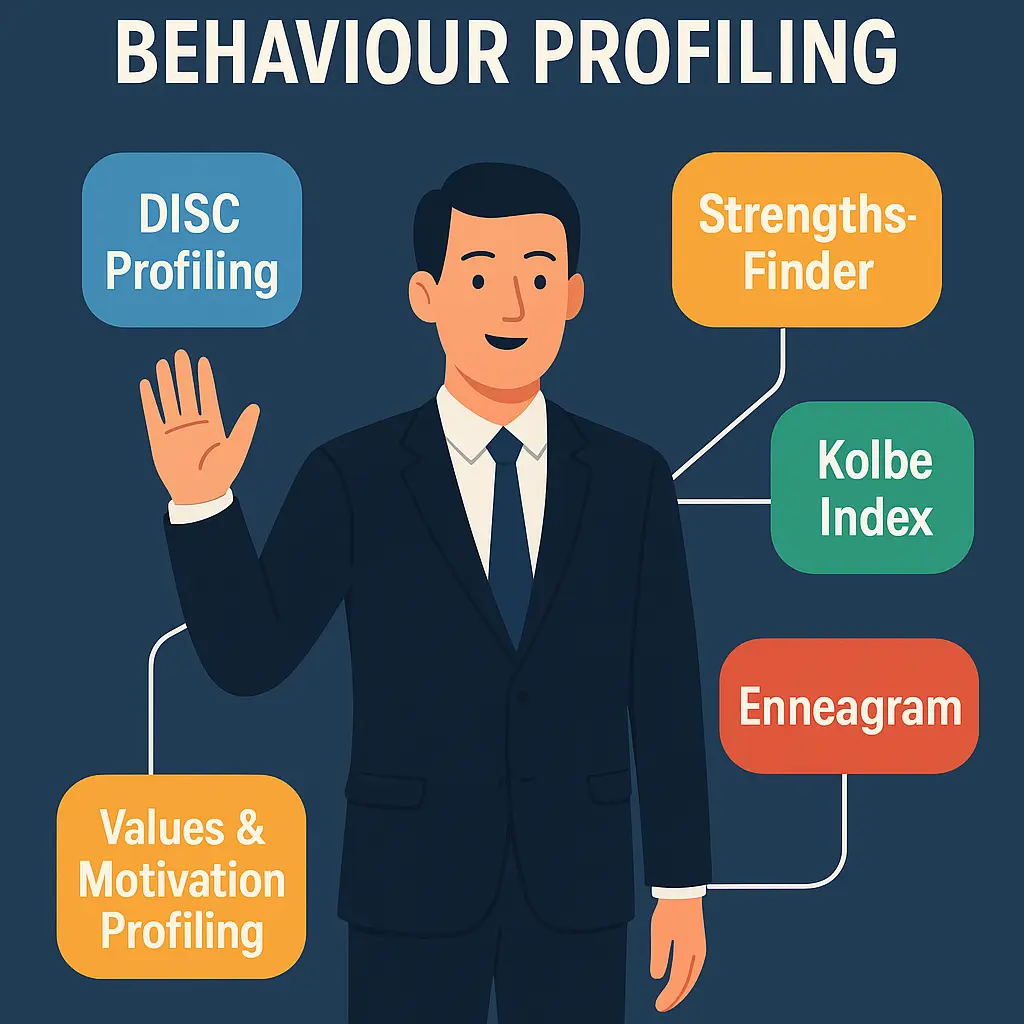
Behaviour profiling is the practice of using structured assessments to reveal how people prefer to behave, make decisions, communicate, and interact with others. These insights can:
- Improve team performance
- Reduce conflict and misunderstandings
- Help leaders match people to roles
- Enhance coaching and development conversations
- Strengthen workplace culture and employee engagement
Let’s explore the key profiling systems used in business and leadership today.
✓ DISC Profiling – Behaviour in Action
DISC is one of the most widely used behavioural models in business. It maps behaviour across four key traits:
- D – Dominance: Direct, decisive, competitive
- I – Influence: Outgoing, enthusiastic, persuasive
- S – Steadiness: Supportive, patient, reliable
- C – Conscientiousness: Detail-oriented, analytical, cautious
Popular DISC Resources:
- We Hug in Hallways Here by Roger Wenschlag – DISC in workplace culture
- Pumped Up People by Parkin et al – Australian guide to DISC in teams
- Turning People On by Judy Suiter – Motivating others with DISC
- Coaching for Change by Shawn Hayashi – Using DISC in Coaching
- www.ttidisc.com, www.integroleadership.com.au, www.cuttsgroup.com
Applications:
- Team-building sessions
- Sales training and customer communication
- Leadership coaching and conflict resolution
✓ StrengthsFinder – What You Do Best
Developed by Gallup, StrengthsFinder helps individuals identify their top 5 talents out of 34 categories. It shifts the focus from weaknesses to maximising what people naturally do well.
Key Themes Include:
- Strategic Thinking (e.g., Analytical, Futuristic)
- Relationship Building (e.g., Empathy, Positivity)
- Influencing (e.g., Command, Communication)
- Executing (e.g., Achiever, Responsibility)
Essential Reads:
- StrengthsFinder 2.0 by Tom Rath
- Strengths-Based Leadership by Rath and Conchie
- Now, Discover Your Strengths by Buckingham & Clifton
- www.gallupstrengthscenter.com
Use Cases:
- Building well-rounded teams
- Role alignment and employee engagement
- Personal career development
✓ MBTI – Myers-Briggs Personality Preferences
The Myers-Briggs Type Indicator (MBTI) categorises personality based on four dichotomies:
- Extraversion (E) vs Introversion (I)
- Sensing (S) vs Intuition (N)
- Thinking (T) vs Feeling (F)
- Judging (J) vs Perceiving (P)
This results in 16 personality types (e.g., ESTJ, INFP), each with a preferred way of thinking, deciding, and interacting.
Resources:
- A Guide to the Development and Use of the MBTI by Myers-Briggs & McCaulley
- Please Understand Me I & II by Keirsey & Bates
Strengths:
- Team compatibility and communication
- Leadership development
- Managing diversity in thought and style
✓ Kolbe Index – Natural Problem-Solving Instincts
The Kolbe A™ Index measures how people instinctively take action when free to be themselves. Unlike DISC or MBTI, it focuses on conative strengths — your mental energy for doing, not feeling or thinking.
Kolbe Action Modes:
- Fact Finder – Details and information
- Follow Thru – Systems and organisation
- Quick Start – Risk-taking and innovation
- Implementor – Practical hands-on problem solving
Learn more at www.kolbe.com
Business Uses:
- Role fit and hiring
- Workflow improvement
- Conflict reduction in collaborative work
✓ Enneagram – The Nine Core Personality Types
The Enneagram describes nine personality types, each with a unique core motivation and worldview. It blends psychology, motivation, and spiritual development.
The Nine Types:
- The Reformer – Principled, purposeful
- The Helper – Caring, interpersonal
- The Achiever – Success-oriented, adaptable
- The Individualist – Sensitive, introspective
- The Investigator – Analytical, private
- The Loyalist – Committed, security-oriented
- The Enthusiast – Spontaneous, versatile
- The Challenger – Confident, decisive
- The Peacemaker – Easy-going, supportive
Top Reads:
- The Enneagram Made Easy by Baron & Wagele
- The Wisdom of the Enneagram by Riso & Hudson
- The 9 Ways of Working – Workplace applications
Enneagram’s Power:
- Personal growth and emotional intelligence
- Understanding leadership shadows
- Deepening team empathy and communication
Values & Motivation Profiling
While behaviour and thinking styles are important, values determine why people behave the way they do.
Tools to explore values:
- Managing by Values by Ken Blanchard & Mike O’Connor
- Exploring Values: The Power of Attitudes by Suiter & Carlisi
- Who Am I? by Dr. Reiss – The 16 core desires that shape motivation
- MBTI Step II Values Exploration
Uses:
- Culture and recruitment alignment
- Motivation mapping
- Leadership vision setting
Leadership Profiling
Great leaders need self-awareness. Combining behaviour, strength, and values tools gives leaders clarity on how they lead and how others experience them.
Recommended Titles:
- Developing Leadership & Character by Zigarmi, Blanchard et al
- The Platinum Rule by Tony Alessandra – Adapting to others’ styles
- Good Boss, Bad Boss by Robert Sutton – Behavioural leadership truths
Sales & Resilience Profiling
Top sales performers share traits like optimism and bounce-back ability. Profiling can identify these key traits in hiring or development.
Key Tools:
- Learned Optimism by Martin Seligman – has an Optimism Test
- Adversity Quotient by Paul Stoltz – has a Resilience Test
- SPG II Gold Test – Sales Profiling Test
Applying Behaviour Profiling in Business
Here’s how profiling tools can be used across a business:
✓ Hiring:
- Align personality and behaviour with role expectations
- Avoid mis-hires through deeper insight
✓ Team Building:
- Improve collaboration and reduce conflict
- Match roles to strengths and working styles
✓ Leadership:
- Boost self-awareness and adaptability
- Lead with authenticity and influence
✓ Sales & Customer Service:
- Tailor messages to buyer styles
- Build stronger rapport and trust
✓ Training & Coaching:
- Personalise development plans
- Spot hidden potential
✓ Company Culture:
- Shape values-based hiring and engagement
- Develop leaders aligned with vision and values
Action Checklist: How to Start Using Behaviour Profiling
- Choose 1–2 profiling tools that suit your culture and business goals
- Train your leaders in interpreting and using profiling results
- Use profiles in hiring, onboarding, coaching, and team planning
- Encourage self-awareness without labelling or boxing people in
- Protect confidentiality and use tools ethically
Using Behaviour Profiling to GROW
Behaviour profiling is not about putting people in boxes — it’s about giving them room to grow. When used well, these tools help leaders communicate more effectively, teams collaborate more smoothly, and organisations build cultures that work for humans.
Want help using profiling tools to grow your business or develop your team? Contact us to explore custom workshops, leadership retreats, and profiling support.
More References on Personality Profiling
DISC BEHAVIOURAL TRAITS
- If I Knew Then What I Know Now by Bill Bonnstetter
- Surrounded by Idiots – Series of books
STRENGTHS
- www.gallupstrengthscenter.com
VALUES & MOTIVATION
- MBTI tests – Myers Briggs Tests for Values
- A Guide to the Development & Use of the MBTI by Myers Briggs & Mc Caulley
- Please Understand me I & II: Character and Temperament by Keirsey & Bates (sim to MBTI)
ENNEAGRAMS – PERSON TYPES
- Are You My Type, Am I Yours? By Baron & Wagele (Enneagrams)
LEADERSHIP SKILLS
- Developing Leadership & Character – Knowing enough about yourself to lead others by Zigarmi, Blanchard et al
- The Platinum Rule: Discover the Four Basic Business Personalities – by Tony Alessandra & Michael J. O’Connor
- Good Boss, Bad Boss by Robert Sutton (Stanford Uni)